ParenTime MVP Launch
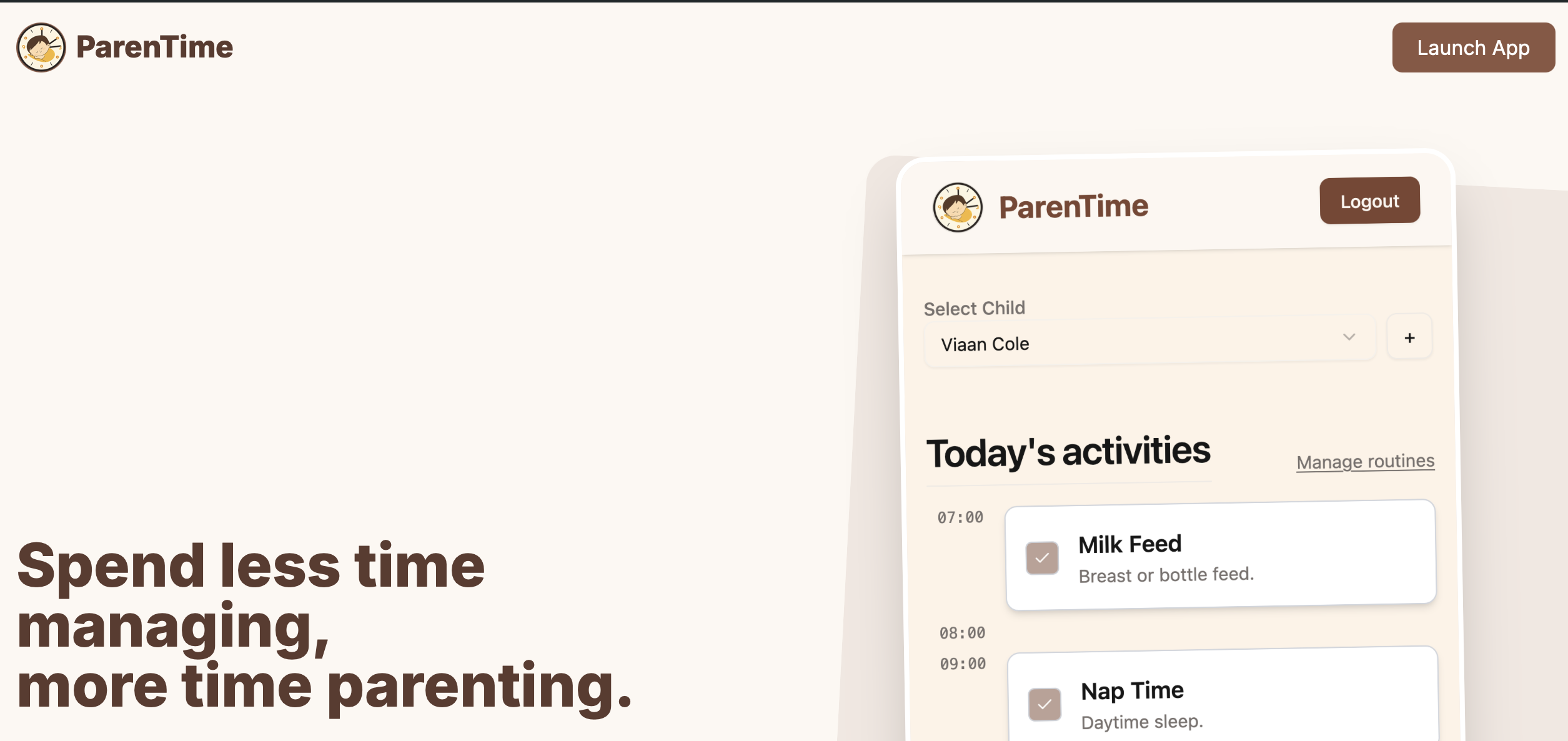 It took way longer than I planned, and deviated from said plan in some significant ways, but I took it live - as rough as it may be. ParenTime is launched - an app I built for my wife and me to help make tracking activities for our son a bit easier! Check it out here: app.parentime.co.za. Be warned - it needs a lot of work still!
What changed since last time
I wrote a bit about Building ParenTime around Q2 2025, and the goal and tech stack largely remained the same - the notable exception being PostgreSQL being swapped out for DynamoDB. The main reason for this - cost. I had the solution working well with PostgreSQL, but hosting a PostgreSQL DB in AWS proved too costly for this MVP, and so did using a service like Neon to host the DB, as the AWS egress cost to communicate with the DB also made it a bit too prohibitive for my use case.
Besides that, the setup as described in my infrastructure post remained on point! What did change though - features! What I thought was ‘MVP’ enough was still too large to build as an ‘in my spare time’ side project - stripping the features down to the absolute bare minimum was needed in order to call it ‘done’ - or at least done for now.
If you’d like to hear more about the change to DynamoDB or how I cut down the features - let me know!
What went well
Here’s what I liked and enjoyed about this process:
Building it by hand
I built it up by hand, as one of the main drivers for doing so was to learn more about AWS and about TanStack Start. Relying less on tooling, especially AI tooling, helped me do that! I learnt an absolute ton of information doing so, at the cost of time.
Ruthless cutting of features
In order to get to the finish line, ruthlessly cutting the app down to its bare minimum was required. It’s not that I’ll stop working on it after this, but without launching it, it becomes a never-finishing side project, among all the others. This is a great boost for me mentally even if there are many things I would improve about it, as I know I still can, but also that it is live and usable right now!
Finding time to build
I started off with some dedicated hours in the evenings to build the app, and that started out great! However, life happens. That time became a bit inconsistent, and progress slowed down. I switched tactics a bit and spent a bit of time breaking down tasks into much more granular pieces.
The smaller tasks helped me when I had 10 or 30 minutes to spare to quickly pick up the task and finish it, giving the sense of tangible progress even when time was limited.
What I would do differently
While a fair bit went right, there were definite shortcomings that I learned from:
Setting up CI/CD earlier
From the AWS infrastructure to actually deploying the app, I was running everything manually from my laptop. This was easy but tedious and time-consuming (and error-prone!). It ate up time every slot I had to work on the app, and often put me off working on it altogether.
Once I actually set up automated pipelines to deploy infra and code changes, it was like a weight was off my shoulders. The worst part is - it didn’t take long at all to set up. Both Terraform and TanStack Start have straightforward build and deploy steps, and the only thing holding me back was me.
It’s often easy to justify putting it off as it’s not a value-adding feature, which has some truth to it. However, at a certain point, setting it up is worth the very short pain.
AI Assistance
While I was glad to have learnt a lot by doing everything myself, were I to start again I would seriously reconsider not using any AI-assisted tooling.
Tools like NotebookLM are useful for speeding up learning - which would have helped speed up some of my learning on AWS and TanStack Start.
Should I choose to opt for prioritising building and launching an app, I would definitely lean on AI tools to speed up development. The advances in recent months have really made it a much more reliable tool that can greatly speed up your workflow. It’s always important to note though, that it is just a tool, and the quality of the output is still the responsibility of the developer.
What’s next
Unfortunately, because this app took a whole lot longer to build than expected, we don’t have immediate use of it. Our son’s routine is not nearly as overwhelming to maintain now that he’s no longer a baby (or even a toddler, really).
Who knows, maybe we’ll find a use for it in the future, or maybe it’ll evolve into another app for a different purpose. Or, if you find it useful, let me know and we can work on adding in new features that YOU need!